Conrad and the Big Bad Problem
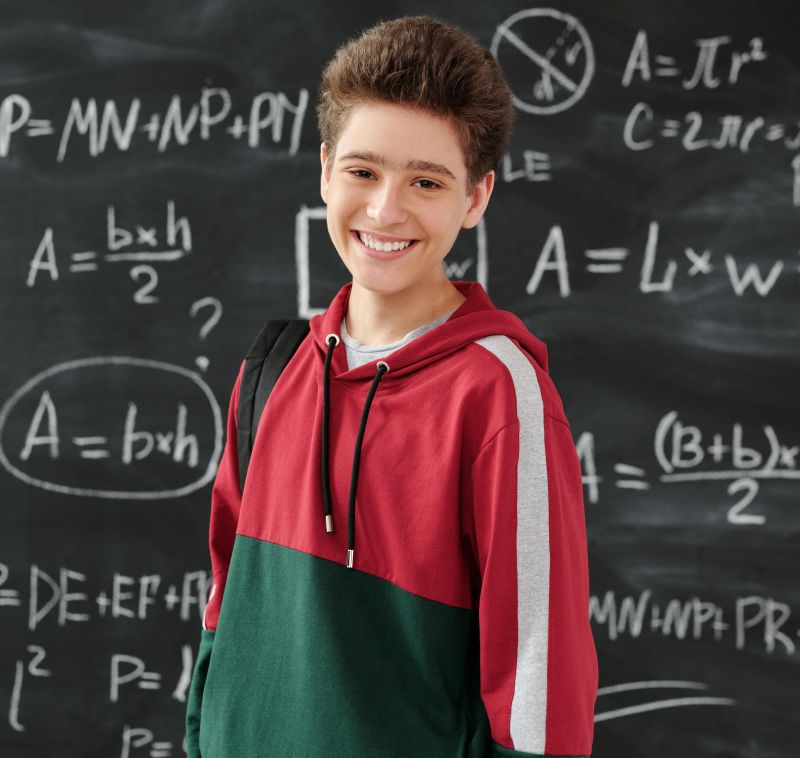
by Cole Parker
colepark@gmail.com
This is going to be tricky. I don’t want to do it, but I need to. Just not sure how.
I do know why I’m even considering doing it. My brother had Mrs. Andrassy a few years ago, and he told me she was the teacher he liked best of all the teachers he’d encountered in high school.
“It’s not just that she’s friendly—which she is—or that she’s nicer than any of the other teachers you’ll have there. It’s something else. Something not even about math.”
“What?” I asked.
He shook his head the way he did when he was uncertain about something. “It’s hard to define. She’s the only Math teacher I ever had who was sympathetic to the kids who found math almost indecipherable. The ones who gave up on it. A lot do. She cares; she takes the time to help them; help everyone, really.
“But it’s not just with math. She’ll help with whatever problems kids bring to her, problems about anything. She always has time for them. What it is, I think, is that she has this sincere empathy for kids.”
He patted me on the back. ”You’ll find that most of the teachers there have lost that, if they ever had it to begin with. You can’t get close to any of them; they keep you and your problems at arm’s length. They won’t meet you on a human level.
“That’s not true with Mrs. Andrassy. She’ll listen to you. Respond to you. Understand what you’re saying. She cares. She’s unique.”
I’ve just entered her classroom for the first time. I don’t know her at all. She assigns us the seats we’re to sit in. How does she do that, not knowing any of us? It’s not alphabetic, I can see that easily enough. We’re all freshmen, and this is our first day in high school. But she has a chart with all the seats in the room on it, and she’s written all our names on it. I’m in the first column of seats, next to the wall, a few rows back, maybe halfway to the back of the classroom.
She’s up in front, sort of perched on the front of her desk, talking to us. Explaining what we’ll cover in the class and what behavior she expects from us while we’re in her room.
It seems to me this could be a very stern lecture, but no. Surprisingly, she makes it sound like an amiable chat, smiling as she’s speaking, and she emphasizes that we’ll enjoy her class, especially if we apply ourselves. “And the class won’t be painful,” she says. She tells us the way she teaches Math will make it easy for anyone to understand.
She looks middle-aged to me or perhaps a little past that. There’s gray in her hair, but I find her age isn’t something that matters much when facing her. I hardly notice it. She has a friendly face and voice and speaks with plenty of energy and enthusiasm. She’s wearing dark-green slacks and a blouse of a complementary lighter-green color that has a hemmed bottom; it’s untucked and overlaps the top of her slacks. She looks almost jaunty.
She’s tall, not quite six feet but not a whole lot less, and she’s slender. I wonder if she was an athlete when younger. Or maybe she still is. A lot of older people are now playing pickleball. I’m not very athletic. She could probably beat me.
One thing that stands out to me is how confident she sounds while speaking to us. There’s no doubt, none at all, that she’s in charge here, that there’ll never be a problem she can’t take in hand, and somehow that’s evident even while sounding so nice.
I realize I’m letting my mind drift, which is a bad habit I have. I snap out of picturing her playing pickleball just in time to hear her say, “Class participation is important. You’ll learn much better by being involved in the lessons with each other, and part of that will happen when I call people up to do problems on the board. That will lead to our discussing them as a class.
“If something is wrong with the problem you’re putting on the board, I don’t want you to be embarrassed. If you make a mistake, others in class will have made the same mistake, and this is how you all will be learning as a group, how to work these problems. I’m being sneaky, too. I’ve found that if you know you could be called up, you’re more likely to have done the homework and so won’t be anxious about showing others your work. What is embarrassing is trying to do a problem on the board you haven’t already solved at home.
“But I really don’t want to embarrass any of you, and that won’t happen if you come to class prepared.”
Okay, now I know. Todd, my brother, told me what the class was like. He knew I’d worry about math. It’s my weakest subject. Somehow, unknowns and variables and equations and factors don’t register with me. Todd loves math. I don’t.
When he’d told me that I’d love Mrs. Andrassy, I’d been skeptical because he’d reacted differently to Math teachers than I had.
But Todd had told me that we’d have class participation in her class, and her talk about no embarrassments seems hopeful on her part and threatening to me. I know I’ll have trouble with the problems she’ll assign and being called to the board, which Todd said she meant by class participation . . . yeah, this won’t be pretty. Big time embarrassment coming to the location nearest you. Just not sure when or why.
But if she is empathetic, like Todd said, and, well, perhaps she’ll realize calling me to the board is a big mistake. However, I need to talk to her about my problem, anyway. As soon as we’d settled into our assigned seats, I knew how important it was for me to do that.
Just how to do that—to say what I need to say—I haven’t figured out. Hey, I’m 14 years old. I have the confidence of a shy mouse in a house full of cats. That is, none at all. How can I possibly talk to her? Say what I need to say? About this?
o o o
After class, I ask her if we could talk when she’d be available. She says after school would be best. Great! Now I have all day to worry about that meeting. Just what I need!
When I walk into her classroom at the end of the day, she’s at her desk, looking at the seating charts. No papers to grade yet.
“Mrs. Andrassy? Hi. I’m Conrad Masterson. Uh, I told you that earlier when you were taking attendance. Sorry. I’m a little nervous.”
“That’s okay, Conrad. Let’s find a more comfortable place to sit.”
She walks me across the hall to the teachers’ lounge. No one’s there to hear us. We sit in comfortable chairs facing each other. The room is much less stark than an empty classroom would be. The carpeting on the floor helps. There are some green plants on window ledges and tables, some bookshelves with magazines on top and both hardcover and paperback books that show some wear. There’s a coffeepot and a refrigerator that I can imagine has soft drinks in it. There are three couches as well, and they show use.
When we’re comfortable, she says, “Hmmm. Conrad sounds too formal, not a name that other kids would like using. Kids like to shorten names as much as they can. I try to get to know my students as informally as I can; easier to talk to them that way. Do you have a nickname? What do your friends call you?”
“Well, Rad, I guess.”
“You guess?” She laughs, but I can tell it isn’t at me, more at the absurdity of my not knowing what kids call me. That could be humiliating, but somehow, even her laugh is friendly. Makes me think, though. Why did I add ‘I guess?, anyway? Just nerves and lack of confidence. I tend to do that, be self-deprecating. Todd told me it was a defense mechanism, but he knows more than I ever will. He’s the smart one in the family.
“Is it all right if I call you Rad, then?”
“Sure.”
“Okay then, Rad. What did you want to discuss with me?”
She smiles again. I can see why Todd liked her. Me? I’m just nervous and not thinking about liking or not liking her. I’m here to ask her for something, something I have no business asking. I don’t know how to bring it up, either. But damn, I need to. It’s important!
“I need to ask you for a favor, but I don’t know how to do it,” I manage to say.
“Hmmm. Well, I can’t guess. You’ll just have to figure that out. Maybe you can come back later when you’re ready.”
“No, I have to do it right away. Now. Maybe if I just start talking, I can work my way to it. I have to do this.”
“Okay, go ahead. Just start talking.”
Another smile. Maybe even a repressed laugh. Todd was right: she’s friendly. Not a bit threatening or intimidating. Encouraging, really. Easy to talk to.
“As I said, I’m Conrad Masterson. You had my brother Todd a few years ago. He’s starting college this year. He told me you were the best teacher he had here. He told me if I ever had a problem that I needed to talk to a teacher about, you were the one to choose.”
I stop. That was a lot to say. I’m watching her, seeing how she reacts. So far, so good.
“I remember Todd. Good student, good person. Also good at math.”
She stops. I can see I’m going to be the one doing most of the talking. Scary, but that’s what I’m here for.
“Well, I’m not good at math. I get good grades in other subjects. Math is my worst one.”
I stop again. That was hard to say. It might annoy her. She might get the wrong impression about me.
“Well, I hope we can fix that.” Rather than angry, she looked amused. “Same genes as Todd, probably just as smart. Maybe we can figure out what your problem is and find a way to help. I’ll certainly be available for extra sessions if you ask.”
“Thanks. I’ll probably need to do that. I don’t get equations and unknowns.”
“I’ll show you how to work with those.” She stops and fixes me with her eyes. Then: “But I don’t think that’s what you came to talk to me about, is it?”
I frown. “How did you know that?”
“Because of the way you’re fidgeting. You’re very nervous, and talking about math shouldn’t be affecting you like this. I think it’s something else, maybe something more personal. A particular math problem could be discouraging, but talking about it in advance shouldn’t be. Look, Rad, let’s not dance around this. Face up to it, whatever it is, and get it out on the table. You came in to do that. I’m here to listen. You must either get to it, or we can get together again when you’re ready.”
Damn. She says that with sympathy in her voice and eyes. This has to be the empathy Todd spoke about. It does give me some courage, the feeling she’s on my side. I don’t know if it’s true, though, but I keep going.
“I need to do this. You’re right. It’s just so hard! I need to say things that you just don’t say to a teacher, a teacher you don’t know and she doesn’t know you, even if she’s one who my brother said has empathy.”
She smiles again. “That was kind of him. I always liked Todd. But let’s focus on you. Look, over the years I’ve heard just about everything. I’m here to help you. You have a problem. What is it?”
Could I? Well, I needed to, and she wanted me to. I open my mouth, then close it. Then open it again.
“Okay, I’ll try. It started when you assigned seats. That causes me a ton of trouble. Makes it great big bad problem, really”
“I can talk about why I do that if you want. My seating arrangements. I look at the records of all the incoming kids I’ll have, and I separate the ones who might be disruptive. I seat them apart from each other. I keep the better kids mostly in the middle of the room and the potential problem ones up closer to the front. I take a lot of time with these seat assignments. I don’t want to change them willy-nilly.”
“Oh, I didn’t mean I wanted to change my seat. I don’t. It’s just . . .”
When the pause grows, she says, “Now I’m confused,” and shakes her head. But she’s still smiling, and the smile is encouraging me. It’s like she’s saying her confusion is her fault, not my stumbling all over myself.
“I’m going to have to talk about it, aren‘t I?” I try to smile, too. I have no idea what it looks like.
She nods. My turn.
“Okay. This feels awful, saying this, but not saying it may be worse. It’s just that . . . darn! Okay again. Maybe I can get into the problem this way. You know we have Sex-Ed classes. We did last year, and we have them again this year.”
“Yes, I know that.”
She stops, which makes it easier for me as she could have started talking about sex-ed things that would have both embarrassed and distracted me, and I am almost on a roll now.
“So . . . well, you’re an adult, work in a high school, so you must know about boys my age, and, uh, the problems they can have. They can be worse at school.”
“I think I know what you’re talking about, but I don’t see . . .”
It was her turn to stop in the middle of what she was saying. Her eyes showed she’d had a thought. She didn’t hesitate long. She was braver than I was.
“Is your problem that I’ll be asking you to go up to the board when you have an erection?”
I blush. Can’t help it. Damn. But we are there now, and I have to use what momentum I have. “Well, kinda. But it’s not that precisely. There’s more to it. The thing is, yes, that’s a problem, but for me, uh, it’s kinda worse. I need to tell you why and then ask a favor of you. Okay?”
“Okay. But Rad, look. You’re incredibly brave talking to me about this. Now I understand all the fidgeting and evasion. I understand this has to be terribly important to you for you to come to me about this, to have this conversation. I can only meet your courage with this: I’ll do what I can to help with whatever your problem is that relates to what you’ve just admitted.”
I take a deep breath. “My problem isn’t about screwing up a math problem on the board. It isn’t even just about going up front with an erection.”
I blush again. I just said ‘erection’ referring to my own erection! To a teacher! Not a Sex-Ed teacher in a Sex-Ed class, either. I said it in the teachers’ lounge with just the two of us together. This is awful!
She sees my emotions and tries to calm me. “Rad, this is a conversation I haven‘t had before. Something I didn’t think was possible. But I can see you’re upset, and I understand your reluctance to be talking about this. But you’re doing fine so far, and I have no problem talking about this. I’m not sure how I can help, but you haven’t told me what the problem is exactly. Can you do that?”
I can. “Well, see, it’s partly your seating assignments. That’s the problem—or the beginning of the problem. Not where I’m sitting. Where someone else is sitting. I have to look right at him—” I almost stumble there, and it would have been disastrous. I catch myself and continue without even the slightest pause “—or her to see you and the board. I have the biggest crush on this person, bigger than I ever had before. You must know about crushes and about 14-year-old boys and how strong they are. The crushes, not the boys.”
She laughs, again not at me but just how strange and awkward this conversation is. I don’t laugh. I don’t feel a bit humorous. I rush ahead.
“If you’re speaking to me directly, I’ll be looking at you directly, too, and when doing that my eyes will be seeing, uh, this person. And I’ll, well, you know. The problem we just mentioned? It’ll occur then, and walking up front, right past h—” oops! “im or her is going to make the problem much worse and much more obvious.”
“I see. This is a problem easily solved. I’ll just change your seat.”
“No!” Oops. I didn’t mean to say that so loudly. “I like sitting where I am, and like looking at, well, this person. It’s that I’ll be called to the board just when I’m seeing the person I’m seeing. I don’t want to go to the board then. But I can think of a way to help. You probably think this whole thing is frivolous, but to me it isn’t. As I said, there‘s more to it. It isn’t frivolous.”
I stop to breathe, then continue. “I do have a suggestion, the favor I mentioned, but I don’t think you’ll like it.”
I pause again. This is coming out in gushes and spurts. Now I’m about to ask a favor of someone who’s way above me in age, responsibility, maturity, authority—well, it’s difficult. For me at least.
“What is it?” There could be impatience, even anger in her voice, but all I hear is a thin smidge of humor. Maybe she’s enjoying this, but I’m not!
“What I’d like is for you to agree to do something. It’s simple. I can give you a signal, and it’ll mean ‘uh-oh, it’s happening,’ and you can call on someone else instead. My signal could be as simple as raising one finger.”
“So you want me to bypass your appearance at the board at your signal. Your decision?”
“I know, I know, it sounds bad. It sounds like I’d do this just to escape going up front when I’m not prepared. But I can make you a solemn promise. I’ll never do that. If I don’t know how to solve a problem, or if I didn’t do the homework and you call me to come up, I’ll still come up. I’ll come up unless I have the problem we’ve been talking about and I give you the signal. I’ll be honest with you.”
I look at her hard, hoping she sees the sincerity in my eyes, hears it in my voice. She looks back just as steadily. Then she looks away and turns in her chair so she’s facing the windows instead of me.
She turns back. “Other boys have this problem, and as you say, they manage. Why can’t you?”
Damn. This isn’t getting any easier. I try to smile. She smiles back and remains mute. “Yes, we do know ways to hide the problem. But this would be worse for me. The only way for me to get to the front is walking up the aisle right next to his desk. And if—” Damn. Now I’ve done it. As soon as I say that, I realize what I’ve done. Well, no way I can stop now. I shake my head and continue “—every time I walk past him, I’m in that condition, well, he’ll see what there is to see, and he may well put two and two together, to put it in mathematical terms, and he might get the idea maybe he’s the reason for it.”
“Isn’t that stretching a bit too far? Why would he think that?”
She doesn’t comment on the mistake I made. But I’m sure she heard it. I need to address that, as terrible as it is.
“I realize I made a mistake back there, said something I didn’t want to, but I can’t do anything about it now. And in any case, maybe now you can see this is more than a trivial problem. No one knows about me. Except now you do. You and me. It’s my biggest secret. That I’m gay. And I have a crush on a boy in your class. That I’m gay has to stay a secret. Has to! To answer your question about why he’d think he’s the cause of my erections, well, yes, maybe he won’t think he’s the cause. But the thing is, I think he might be gay, too. Maybe that’s why I’m crushing on him like I am. But if he is, and every time I walk past him he sees me, and if he’s gay, maybe he’ll wonder about me. I can’t have that.”
I have to stop. I’m about at the end of my resources. I’m feeling about two inches tall at this point. But there’s nothing to be done but try to soldier on. At least my voice didn’t break. It felt like maybe it would. What I can’t do now is meet her eyes. I look away.
She pauses, probably to allow me to get control of myself. She heard how upset I was from my voice. Then she says, “We could do the signal. I trust you. You’re trusting me now, whether you wanted it that way or not. But let me ask about something you didn’t think of. What about this? Instead of calling on you so you have to look right past this person to see me, I could move to the side before calling you. Would that help?”
I have to imagine that. I take a moment to do that. “Maybe. Possibly. I was worried when I asked you to respond to my signal. It seemed too much to ask. Now you’re going further, being willing to move so I won’t have my problem. You’d have to remember to do that.”
“But it might solve the problem?”
“Maybe. Maybe not.”
She nodded. “I could do both. If and when I forget to move and your problem arises—sorry about that; I couldn’t help myself—I’ll see your finger and call on someone else. Otherwise, you should be safe, especially after you’ve become accustomed to seeing whoever it is every day as you said.”
I am almost overwhelmed. I never thought she’d agree to help me, nor that I’d have the courage to talk through this. Talk to a teacher I didn’t know about recurring erections? Then let her know I was gay? Give me a break! But Todd was certainly right. Again. He was almost always right.
I get what I wanted from her, and it’s time to go. I take my time leaving, gathering myself, decompressing, letting my breathing and heart rate slow. She is looking at her seating chart, and I suddenly realize what she’s doing. And it can’t be hard. The only boy in the seats between us when the class is in session is my crush.
She looks up at me and grins. “He is cute, isn’t he?”
I blush again.
o o o
The next few days, I get a feel for the school layout, the teachers and the students. It’s nothing like middle school. There’s more energy here, a faster pace, larger kids, and higher expectations of us in our classes. More work, too.
The biggest surprise is that I’m enjoying Math. I’ve never had a math teacher who makes things so clear. Usually, they used terms I didn’t understand without explaining them, they rushed through how some problems were done and then asked us to do them, and I didn’t even know where to start.
That isn’t Mrs. Andrassy’s way. Her explanations are very clear, very precise, and if she uses a term we might not be familiar with, she makes sure we’ve got it before moving on. She explains something, then calls on one of us to repeat the explanation, and if we falter or mess it up, there’s no criticism. She just says she sees she didn’t do a good enough job with that point and goes over it again.
I’m finally working right along with the class, with the lessons, and I’m not hating it! I actually look forward to going into Math class.
My problem? So far, she hasn’t called on me. She’s called on others but not called anyone up to the whiteboard yet. So what’ll happen when she does? I have to wait to see.
I’m sitting in her class when she says, “I’m ready to start handing out homework assignments. You’ve all had it too easy so far.” She laughs at the groans that elicits. “But, I’ve learned that homework goes better if you do it with a friend. That’s because you’ll know how to do some things, they’ll know about others, and you can help each other and get it done faster and with less struggling. You’ll all learn what you need to know better this way.”
Am I hearing her right? That whole statement is suspect to me. She looks at me while saying it, too.
She’s been talking to us while standing next to her desk. Now she moves closer to us, only a few feet from the front row of students. “To make working with someone on your homework easier to arrange, it’s necessary for you to know each other, and I can tell from watching you, this group isn’t well-acquainted. We have to resolve that, and I have a way to do it which hopefully will be fun.
“What we’re going to do is this. We’ll go to the cafeteria which is unoccupied at this time of day. I’m going to separate you into pairs, two of you working together, and spread the pairs out around the cafeteria so you won’t be hearing what any other pair is doing. Then I’m going to give each pair a card with a math problem on it. Each pair is to solve the same problem, then write your names on the card with a brief note explaining how you solved it. You’ll then bring the card to me and I’ll give you another. We’ll keep this up till we run out of time. No phones or calculators. I’ll be watching.
“Some of you will get more problems solved than others. It’s not really a competition, but I know you guys like to be best at whatever you’re doing. I might announce which team turned in the most cards. We’ll see.”
She doesn’t need any hints on how to motivate a bunch of just-teenage students.
We all go to the cafeteria, and Mrs. Andrassy divides us up. She knows every kid’s name! She’s only had us for less than a week. But she knows us. She calls out my name, Rad, and then Tristan’s. I’m being partnered with my crush!
She hands me the card, and I see Tristan walking toward me. Oh my god! My problem jumps to attention. This can’t happen! I lean down to tie my shoe that doesn’t need tying and fix myself as best I can. I’m thinking, too. Tris must know my name! That’s good, isn’t it? I stand up, much less noticeable now, and we step away from the kids gathering around Mrs. Andrassy.
“Hi,” I say, hoping I don’t sound as nervous as I feel. “I’m Rad. But you know that. I know your name, too, though we’ve never met. Do you prefer Tristan or Tris?”
He doesn’t meet my eyes. He’s shy! I thought he might be. I saw him now and then in middle school, and when he was with someone, I never saw him looking at their eyes. I shouldn’t be surprised he’s not looking at mine now.
“Tris,” he says, and that’s all.
“Let’s find a table,” I say, and he doesn’t say anything then, just stands there. I see he’s waiting for me to lead the way. I’ve never thought of myself as a leader. I don’t want us to be a pair where I’m the boss. I’ll have to see that doesn’t happen.
I have no choice right now. I walk to a table that’s not near one that’s already occupied. We sit down.
“What do you want to do, Tris? We could just work on the problem, or we could talk and get acquainted.”
I can see he doesn’t want to make that decision. To make it easier for him, I say, “We could try to do the card; maybe we could do several of them, more than most of the kids are doing, but I have to tell you, I suck at math.”
I look at him, try to meet his eyes. His turn to talk. If I wait, he’ll have to say something eventually.
He does. Eventually. “Let’s see what the math problem is.”
“Okay,” I say, and I hand him the card. It’ll be only polite for him to read it out loud. I’m trying to get him to loosen up.
He reads the card: “What’s the square root of 4,624?”
“How are we supposed to know that?” I ask.
He doesn’t hesitate this time. “We’re not. We’re supposed to figure it out. Trial and error, I think.”
He’s more comfortable talking about math, that’s easy to see. “So we’re supposed to just try a bunch of numbers?”
He shakes his head. “We could, but no. We whittle it down a little. Like, we know one hundred squared is ten thousand. That’s way too big. Fifty squared is twenty-five hundred; that’s too small. So the answer is between those two numbers. We can get it closer by doing more of this. One thing I think we should suppose: I don’t think she’d give us a square that isn’t from a whole number. And we know that the answer is closer to 50 than 100. It’s probably between 60 and 80. You square 60, I’ll do 80.”
Mrs. Andrassy had given each of us a pencil and scratch paper. Tris doesn’t tell me how to square 60, assuming I know. But I see he’s multiplying 80 by itself, so I do the same with 60. He gets 6,400, I get 3,600.
“4,624 is closer to your number than mine,” he says. “But the square of 70 would be 4,900, and that’s just a bit larger than the number we want. So I think the answer is just under 70. Probably 68.”
“Why exactly that?” I ask.
“Because the square we were given has a four as its last number. To get the four, the number we’re squaring has to end in either two or eight. Both of those two, multiplied by themselves, will give an answer ending in four, and none of the other numbers would.”
I’m looking at him in amazement while he proves 68 works. He isn’t a bit shy now, and he really knows this stuff. I see that getting him talking about math, something that he is confident about, makes him a different kid.
“So write it down, and how we got it—how you got it—and I’ll rush it up there. Only one other group has gone up yet. Two girls.”
He writes quickly, hands me the card, and I run up and hand it to Mrs. Andrassy. Running is easy; my problem has ebbed as Tris and I have discussed math.
She hands me another card. I want to talk to her, but I can’t stop thinking about the excitement and enthusiasm I’ve seen in Tris’s eyes, and I need to get back to him.
I hand the new card to him and he reads it out loud. “It’s two equations. They are 2x-3y=6 and 4x+2y=28, with x and y having the same value in each equation. We’re supposed to tell her what x and y are.”
I’m shaking my head all the time he’s reading. “Do you know how to do this? I know Greek better than this, and I don’t know Greek at all.”
He kinda smiles. I hope it’s because of the funny I just made. “I think you’re supposed to add or subtract the two equations together, maybe adjusting one of them so you can eliminate either the x or the y, then solve the x or y that’s left.”
I’m looking at it as he’s talking. I have no idea what I’m doing, but I see something that makes me ask probably a stupid question. “Could we solve either equation for x or y alone so we’d have x equals something that has a y in it, then substitute that for the x in the other equation. Would that work?”
He looks at me, then the problem, then at me, and he smiles. That smile! My problem returns big time. Lucky we’re sitting at a table so my lap is hidden. Whew!
He says, “I think you’re right, and it’ll be easier that way. Let’s see.” He mumbles to himself as he works, kinda repeating the equations and then moving things around so I hear ‘x equals some number and y.’ Then he puts that value of x in one of the equations and almost in a flash, he’s found that x equals 6. A moment later, he says, “Y equals 2.”
He looks up at me and says, “You got it!”
“Uh, Tris. I asked you a question. You’re the one who got it.”
“Yeah, using your suggestion. Take it up!”
“No, you have to write down how you did it.”
He writes, ‘We solved by finding x in terms of y and used that to figure out both x and y individually.’ I take the card and run it up to Mrs. Andrassy. I used the time while Tris was working the problem to make my needed adjustments. No one else has come up yet.
She doesn’t give me another card. She says, “I don’t think too many are going to bring me their cards, so we’ll stop here. I got what I wanted out of this assignment.” She winks at me. “Just use the time left to talk to Tris, if you’d like.”
I look at her and she’s smiling. “I’d like,” I say, and walk back to the table.
When I get there, he asks, “How’d you figure out how to work that problem?”
“I really don’t know. I’m shocked that I did see it. But I’m not so uncertain in Math now. Not afraid of it anymore now, either. I’ve always been afraid of it, and so I never tried. I’ve lost that fear now because of the way Mrs. Andrassy explains things. When I was fearing math, my brain seemed frozen; it didn’t work at all. Now, not being afraid, when I looked at that card, I saw what I saw with a working brain. That’s probably why I could see what I did. But you still did the work and solved the thing.”
“Yeah, but I hadn’t seen the easier way. I like math and think maybe you can, too. I’m . . . I like that we were put together. I like how we worked together.”
Then he looks away. I think he’s been hit by a spasm of uncertainty. Maybe the same self-doubt I feel too often.
I decide to take a small risk. I am feeling really good, and I think he is, too. “I’m looking forward to homework. I’ve never felt that way before. I . . . I’d like to do it with you. I kinda hope we can be friends.”
He raises his eyes to mine for a second, then drops them again. He says, “I’d like that, too.”
We spend the time talking while others are still working on the equations. Tris seems to be getting more comfortable with me. He doesn’t seem as uptight. We return to the classroom with all the other kids when it’s time.
When everyone is seated, Mrs. Andrassy tells us that we all now know someone to work with on our homework if that’s what we want to do. She writes the homework assignment on the board. I make a note of it. The bell rings. Everyone is in a hurry to escape. Everyone but me and Tris.
He approaches me, and some of his shyness has returned, if that’s what his not looking me in the eye means. “Do you want to start doing homework together right away?” he asks me.
“I’d love to. Where? Here in the library after school or at one of our houses?”
He blushes. He actually blushes! Maybe he has some of the same thoughts I do. To save him from any embarrassment, I answer my own question. “Maybe we should use the library at first. We can get to know each other better that way and plan what happens next as we go.”
He smiles and nods, and that means we’re on. I say, “Thanks so much for wanting to work with me, Tris. This’ll be great. Yes! Want to start this afternoon after school?”
He does.
o o o
We’re into the next week before I have a chance to talk to Mrs. Andrassy alone. I’ve been busy! Lots of homework to work on after school. Lots of time spent with Tris.
I stop in her classroom before heading for the library where I’ll meet Tris before we leave for his house. That’s where we do our homework now. His house.
“Hi, Mrs. Andrassy. I just wanted to tell you how great you’ve been. I understand what you’re teaching us! First time ever for math. But I have so much more to thank you for. I just wanted you to know, the help you gave me with Tris . . . well, you changed my life.”
I think she likes hearing that. “How’s that going? I haven’t seen you use our signal even once.”
“Well . . . this is embarrassing again, but you deserve an answer. I don’t have to hide that from him any longer, no more need for that, if you get my meaning.”
“Uh, I think I do,” she says.
She doesn’t blush, but I do.
“This might have happened anyway, but you saved us a lot of time and a lot of worries and fudging around, both being embarrassed. You’ve been just wonderful, Mrs. Andrassy. Really wonderful. Thank you so much!”
Does she blush then or look away or show some embarrassment as I gush? No. She laughs.
The End
Posted 25 February 2026
Image Copyright © Max Fischer. Licensed by Pexels, image ID 5212323